
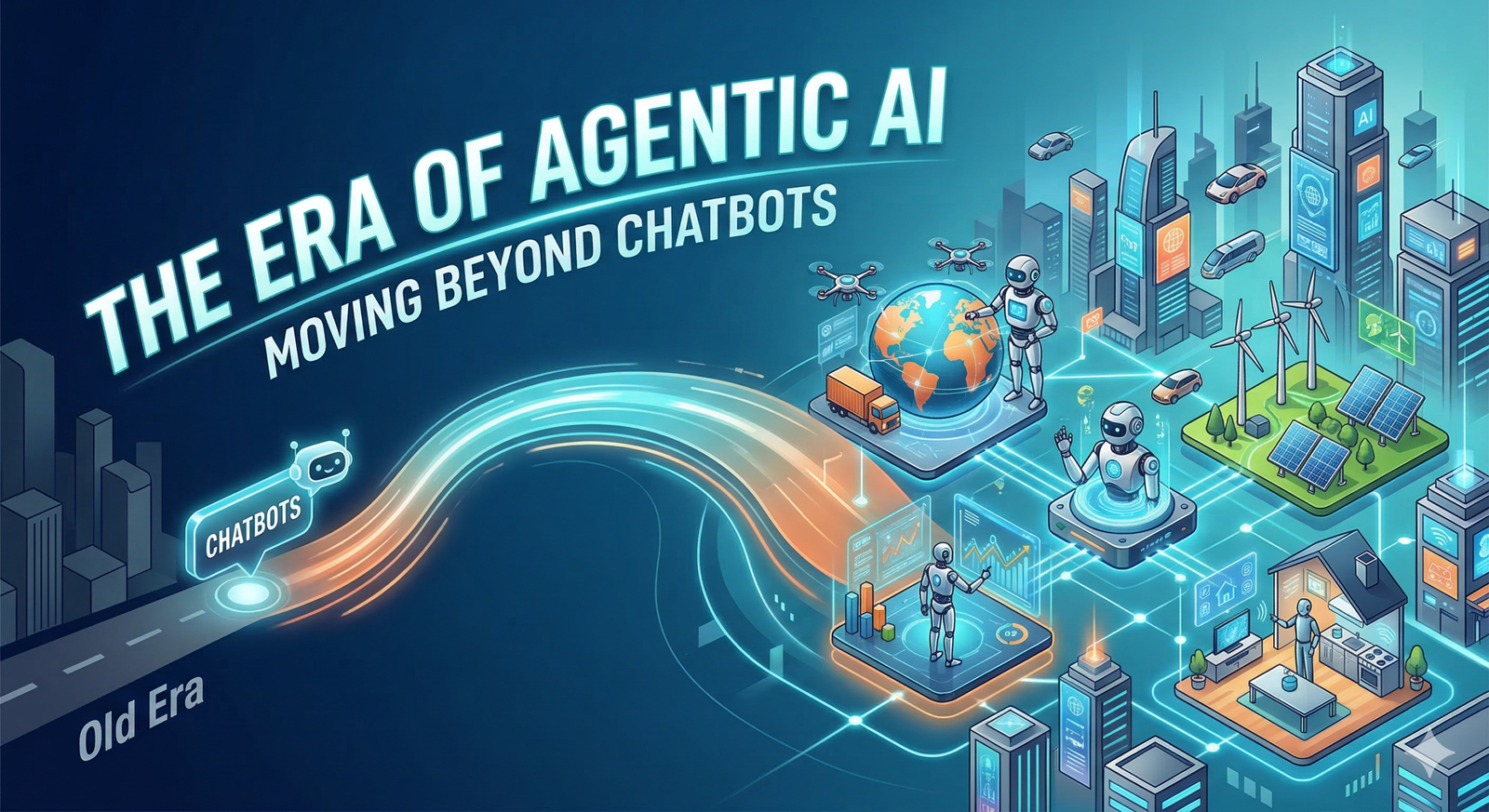
Beyond the Chatbox: Why 2026 is the Era of Agentic AI
Posted on March 5, 2026
For the last few years, we’ve been living in the “Prompt Era.” We type a question, and a chatbot gives us an answer. It’s helpful, but it’s still manual labor. As we move through 2026, Shinetech Publication is tracking a massive shift in the digital landscape: the transition from Generative AI to Agentic AI.
We are officially moving beyond bots that talk to agents that do.
What Exactly is Agentic AI?
Unlike traditional LLMs (Large Language Models) that require constant human hand-holding, Agentic AI refers to systems designed with autonomy. These agents don’t just predict the next word in a sentence; they use reasoning to complete multi-step goals.
If a chatbot is a digital encyclopedia, an AI Agent is a digital employee.
The Three Pillars of the Agentic Shift
Reasoning & Planning: In 2026, agents no longer “hallucinate” as often because they use Chain-of-Thought (CoT) processing. They break a complex goal (e.g., “Organize a 3-day tech conference in Mumbai”) into smaller tasks: venue research, speaker outreach, and budget tracking.
Tool Use (The “Hands” of AI): Modern agents are connected to your API ecosystem. They can log into your CRM, send calendar invites, execute code in a sandbox, and even make purchases using secure digital wallets.
Memory & Personalization: The “Goldfish Memory” of 2023 is gone. 2026 agents possess Long-Term Memory, remembering your brand voice, previous project failures, and specific stakeholder preferences across months of interaction.
From “Chatting” to “Executing”: Real-World Use Cases
The impact of Agentic AI is being felt across every industry, but three areas are leading the charge:
Marketing Operations: Instead of asking an AI to “write an ad,” an Agentic system monitors your real-time LinkedIn ad performance. If it sees a drop in CTR (Click-Through Rate), it automatically generates three new creative variations, runs an A/B test, and sends a report to the Marketing Manager when the results are statistically significant.
Software Development: We’ve moved past “GitHub Copilot.” Today’s agents can navigate an entire codebase, identify a bug reported in a Jira ticket, write the fix, run the unit tests, and submit a Pull Request for human review.
Personal Productivity: Your “Personal Agent” now manages your life. It doesn’t just remind you of a meeting; it sees a conflict, negotiates a new time with the other party’s AI agent, and updates your itinerary.
The Shinetech Outlook: Challenges Ahead
While the “Agentic Era” promises unprecedented efficiency, it brings new hurdles that tech leaders must address:
The Guardrail Problem: How much autonomy is too much? Companies are now hiring “Agentic Ethicists” to ensure AI doesn’t make unauthorized financial or brand-damaging decisions.
Security (Agent-Hijacking): As agents gain “hands” to move data, protecting them from prompt-injection attacks is the #1 priority for CISOs in 2026.
Conclusion: The New Interface is “Intent”
At Shinetech Publication, we believe the keyboard is becoming secondary. In the Era of Agentic AI, your most valuable skill isn’t “prompting”—it’s defining intent. When you can delegate the “how” to an agent, your value lies in deciding the “why.”
Are you ready to stop chatting and start delegating? Stay tuned to Shinetech for our upcoming deep-dive into Multi-Agent Systems (MAS).